The Hidden Mistakes Blocking Your Interview Calls — And How to Overcome Them

You’ve applied to 50… maybe 100+ jobs.
You’ve updated your resume.
Tweaked your LinkedIn.
Applied on multiple portals.
And still — no interview calls.
At this point, it doesn’t feel like a strategy problem.
It feels like something is wrong.
But here’s the truth most people miss:
The issue isn’t effort. It’s direction.
🔍 The Harsh Reality of Today’s Job Market
Recruiters don’t read every application.
They scan.
In most cases, your profile gets:
👉 10–30 seconds of attention
👉 A quick decision
👉 Then either shortlisted… or ignored
This means one thing:
If your value isn’t immediately clear, you don’t exist in the process.
❌ Why 100 Applications Don’t Guarantee Results
Applying more feels like progress.
But in reality, it often amplifies the same mistake.
Here’s what’s happening behind the scenes:
- You’re applying to roles that don’t match your positioning
- Your profile doesn’t clearly communicate impact
- Your resume and LinkedIn aren’t aligned
- You’re competing with candidates who are better positioned — not necessarily more qualified
So instead of increasing your chances…
you’re repeating the same rejection cycle at scale.

⚠️ The Real Reason You’re Not Getting Interview Calls
Most professionals believe:
👉 “I’m not getting calls because I lack skills”
But that’s rarely true.
The actual reason is:
Your profile is not positioned correctly for the roles you’re targeting.
In today’s market, recruiters don’t interpret profiles.
They filter them.
If your experience doesn’t instantly match their expectation,
they move on.
🧠 What Recruiters Actually Look For (But Don’t Tell You)
When a recruiter reviews your profile, they’re not asking:
“Is this person hardworking?”
They’re asking:
- Does this profile match the role immediately?
- Is the value clear without effort?
- Is this candidate aligned with what we need right now?
If the answer isn’t obvious within seconds your application doesn’t move forward.
🚫 The Biggest Mistake Job Seekers Make
They try to fix outcomes…
instead of fixing positioning.
So they:
- Keep updating resumes
- Apply to more jobs
- Follow generic advice
- Hope something clicks
But without clarity, every action becomes guesswork.
What Needs to Change
Before sending another application, ask yourself:
✔ Am I targeting the right roles — or just applying widely?
✔ Is my profile clearly showing impact — or just listing tasks?
✔ Would a recruiter understand my value in under 30 seconds?
If the answer isn’t clear,
that’s where the problem is.
🌍 Why This Gets Worse for Competitive & International Roles
If you’re targeting:
- High-growth companies
- Better-paying roles
- International opportunities
The margin for error becomes even smaller.
You’re competing with candidates who are not just skilled —
but strategically positioned.
🚀 What Actually Works
The professionals who get consistent interview calls don’t:
👉 Apply more
They:
👉 Apply better
They understand:
- What roles they are truly positioned for
- How to present their experience clearly
- How to align their profile with market expectations
That’s what creates results.
💡 Final Thought
If you’ve applied to 100+ jobs without results,
it’s not bad luck.
It’s a signal.
A signal that something in your approach needs to change.
Because careers don’t move forward through effort alone.
They move forward through clarity + positioning + strategy.

📥 Before You Apply Again…
Take a step back.
Instead of sending more applications,
understand what’s actually not working.
If you want a structured view of your positioning and direction:
The New Career Currency: Attention, Trust, and Visibility

Introduction: The Career Game Has Changed
For decades, careers were built on a simple formula:
Get qualified → Work hard → Get rewarded
That model worked in a world where opportunities were limited, competition was local, and visibility was automatic within organizations.
But today, the rules are different.
We live in a global, digital, attention-driven economy where thousands of equally qualified professionals compete for the same opportunities.
And in this new landscape, skills alone are no longer enough.
The real currency of career growth has shifted to:
- Attention
- Trust
- Visibility
1. Attention: The Entry Point of Opportunity
No matter how skilled you are, opportunities begin with one thing:
Someone noticing you.
Recruiters, clients, hiring managers—before they evaluate your capability, they must first see you.
This is where most professionals struggle.
They focus on improving skills internally but ignore how they are perceived externally.
Why Attention Matters:
- You cannot be selected if you are not seen
- You cannot be considered if you are not discoverable
In today’s market, attention is the gateway to opportunity.
2. Trust: The Multiplier of Decisions
Attention gets you noticed.
Trust gets you chosen.
In a world flooded with profiles, resumes, and portfolios, decision-makers are not just asking:
“Is this person capable?”
They are asking:
👉 “Can I trust this person to deliver?”
👉 “Is this a safe decision?”
Trust is built through:
- Consistent positioning
- Clear communication
- Demonstrated outcomes
- Credible presence
Without trust, even high visibility does not convert into real opportunities.
3. Visibility: The Engine of Career Growth
Visibility is not about being everywhere.
It’s about being visible in the right places, to the right people, for the right reasons.
Many professionals mistake activity for visibility:
Posting randomly
Applying everywhere
Networking without direction
But real visibility is strategic.
Strategic Visibility Means:
- Showing expertise in your domain
- Being discoverable in relevant searches
- Communicating value clearly and quickly
- Building presence where decisions are made
Because in today’s market:
If you’re not visible, you’re not considered.

4. The Problem: Why Most Professionals Stay Stuck
Despite being talented and hardworking, many professionals experience:
- Low response rates
- Limited opportunities
- Slow career growth
This is not a capability issue.
It is a signal issue.
Their value exists—but it is not clearly communicated, positioned, or visible in the market.
As a result, they operate in isolation while opportunities flow elsewhere.
5. The Shift: From Effort to Positioning
The biggest career shift today is this:
From working harder → to positioning smarter
Instead of asking:
“How can I improve my skills?”
Professionals must also ask:
“How is my value perceived in the market?”
6. How to Build Career Currency (Practical Framework)
1. Build Attention
- Optimize your LinkedIn presence
- Use clear, role-aligned headlines
- Share insights relevant to your domain
2. Build Trust
- Showcase measurable outcomes
- Share real experiences and learnings
- Maintain consistency in your messaging
3. Build Visibility
- Engage where your industry is active
- Connect with decision-makers strategically
- Position yourself around specific expertise
7. The Future of Careers: Signal Over Skill
We are entering a phase where:
- Skills are abundant
- Competition is global
- Attention is limited
In such a world:
👉 The best candidate doesn’t always win
👉 The most visible and trusted candidate does

Conclusion: What This Means for You
If your career feels slow or stagnant, the answer may not be:
“Work harder”
It may be:
- Be seen
- Be trusted
- Be positioned clearly
Because in today’s economy:
Attention gets you opportunities.
Trust converts them.
Visibility sustains them.
Final Thought
Careers are no longer built in isolation.
They are built in the market.
And the market rewards not just talent—
But clear, visible, and trusted talent.
Get Started
If you’re serious about improving your career strategically:
📩 Email: hr@navyanexus.com
Careers don’t grow by chance.
They grow by positioning.

How to Break Into the Hidden Job Market Today
Introduction: The Real Reason You’re Not Getting Interviews
You’ve done everything right.
- Updated your resume
- Applied to hundreds of jobs
- Optimized your LinkedIn profile
And yet… no consistent interview calls.
At this point, most professionals assume:
👉 “The market is bad”
👉 “There’s too much competition”
👉 “Maybe I need more skills”
But here’s the truth:
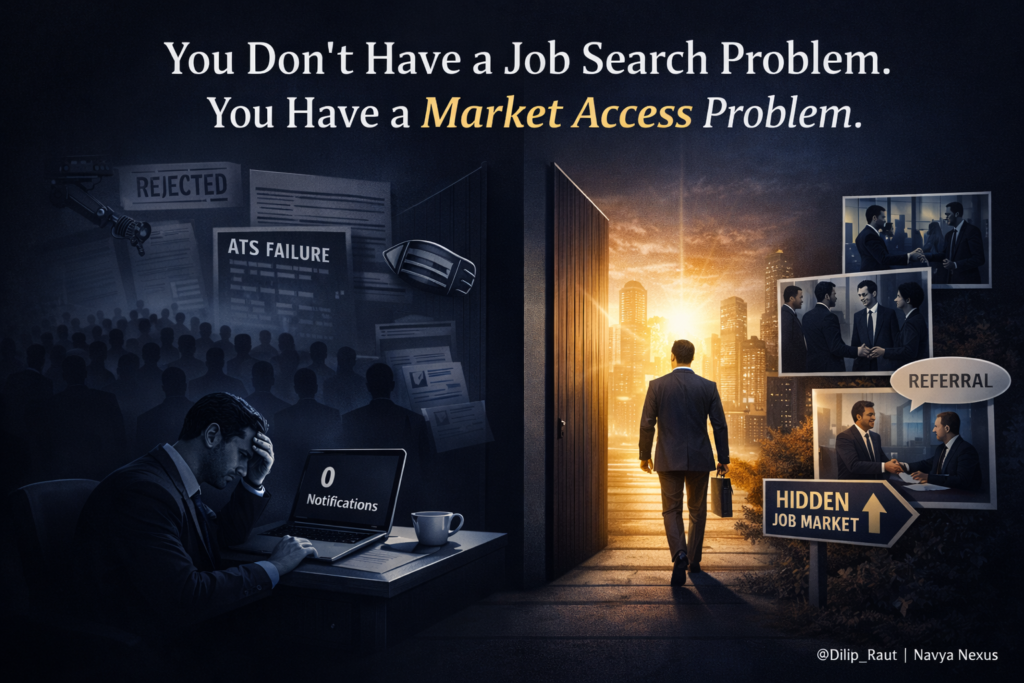
You don’t have a job search problem. You have a market access problem.
What is a Job Search Problem vs a Market Access Problem?
❌ Job Search Problem (What You Think)
- Not applying enough
- Resume not good enough
- Lack of skills or experience
✅ Market Access Problem (Reality)
- You’re applying where everyone else is
- You’re competing in the most crowded channels
- You’re invisible to decision-makers
👉 You’re fishing in the same pond as 1000+ candidates.
The Hidden Reality of Hiring (That Most Candidates Don’t Know)
Most professionals believe jobs come from:
- Job portals
- Company career pages
- LinkedIn job postings
But in reality:
👉 A large percentage of roles are filled without ever being publicly advertised.
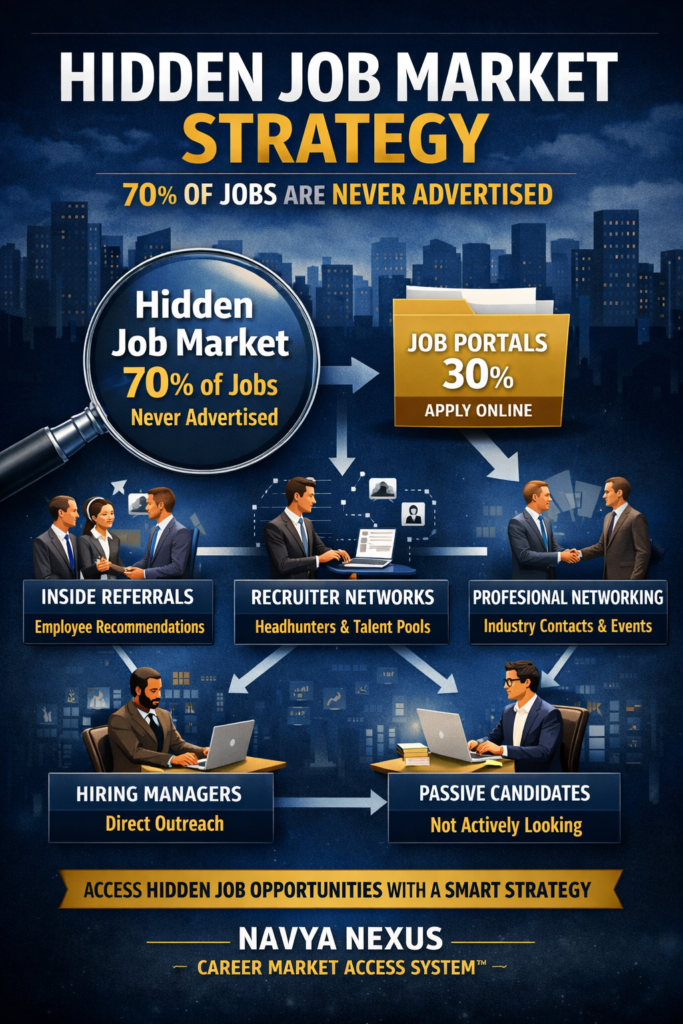
This is called the Hidden Job Market.
Where Real Opportunities Actually Come From:
- Internal referrals
- Recruiter networks
- Leadership recommendations
- Direct outreach & conversations
- Talent pipelines built before roles open
👉 If you’re not in these channels, you’re not even in the race.
Why Applying Online is a Losing Strategy in 2026
Let’s break it down:
- A single job post receives 300–1000+ applications
- ATS filters eliminate most profiles before human review
- Recruiters spend 6–10 seconds per resume
👉 Even strong candidates get ignored—not because they’re bad, but because they’re invisible.
The Real Problem: You Lack Market Access
Think of it this way:
- Job portals = Open competition (crowded)
- Hidden market = Controlled access (high conversion)
Top professionals don’t rely on luck.
They position themselves where:
- Recruiters already trust them
- Decision-makers already know them
- Opportunities come through direct conversations
How Top 1% Professionals Actually Get Hired
They don’t “apply more.”
They:
- Build strategic visibility
- Create authority in their niche
- Leverage networks and referrals
- Engage directly with hiring managers
- Stay inside recruiter pipelines
👉 Result: Less effort, better opportunities, faster offers
Signs You Have a Market Access Problem
If you’re experiencing this, it’s NOT your resume—it’s access:
- Applying daily but no responses
- Getting rejected without feedback
- No recruiter reach-outs
- LinkedIn profile not generating inbound opportunities
- Feeling stuck despite experience
The Shift: From Job Seeker → Market Participant
You need to stop acting like an applicant
and start positioning yourself like an in-demand professional.
That means:
- Moving from applications → conversations
- From visibility → credibility
- From effort → strategy
Introducing the Solution: Strategic Market Access
This is exactly where most professionals struggle.
They:
- Don’t know how to access hidden opportunities
- Lack structured outreach strategies
- Fail to position themselves correctly
👉 And that’s where a structured system becomes critical.
🚀 How Navya Nexus Helps You Fix This
At Navya Nexus, we don’t just provide “Job Market Access”
We help you solve the real problem: Hidden Job Market Access.
Our approach includes:
- Career Strategy Audit
- Positioning & Messaging
- Hidden Job Market Access Strategy
- LinkedIn Authority Building
- Recruiter Psychology Insights
- Job Search Strategy & Execution
- Interview Guidance
👉 This ensures you’re not just applying — you’re getting noticed, approached, and hired.
💡 Final Thought
If you keep doing what everyone else is doing…
you’ll keep getting what everyone else is getting:
👉 Silence. Rejections. Frustration.
But once you fix your market access, everything changes.
📩 Ready to Fix Your Job Search Strategy?
If you’re serious about:
- Getting more interview calls
- Accessing hidden opportunities
- Positioning yourself for better roles
Then start with a Career Strategy Audit.
👉 Email: hr@navyanexus.com
We’ll analyze your profile, identify gaps, and give you a clear roadmap to break into the hidden job market.
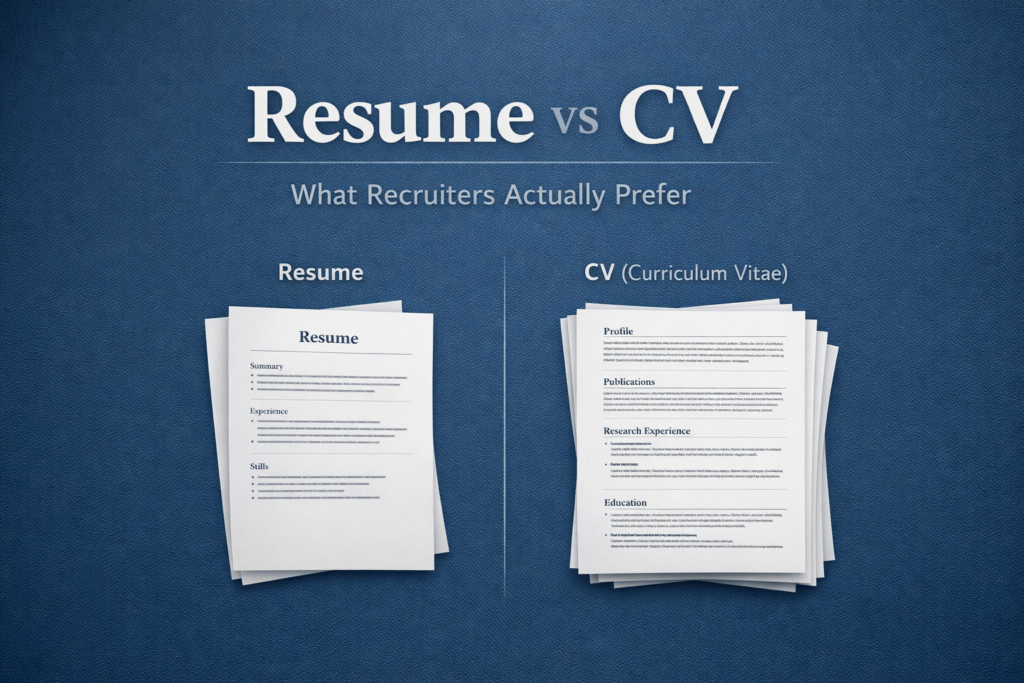
Resume vs CV: What Recruiters Actually Prefer (Difference Explained 2026)
When it comes to job applications, one confusion still costs candidates interviews:
Resume vs CV — what should you actually use?
Most professionals either:
- Use them interchangeably ❌
- Send the wrong format ❌
- Or create documents that recruiters ignore ❌
And the result?
👉 No callbacks. No interviews. No clarity.
Let’s break this down from a real recruiter’s perspective — not Google theory.
🔍 Resume vs CV: The Real Difference

📄 Resume
A resume is:
- Short (1–2 pages)
- Highly targeted
- Achievement-focused
- Customised for each role
Used in:
- Corporate jobs
- Private sector roles
- Startups & MNCs
📑 CV (Curriculum Vitae)

A CV is:
- Detailed (3–10+ pages)
- Chronological
- Covers entire career history
- Includes research, publications, and certifications
Used in:
- Academic roles
- Research positions
- Government / international applications
What Recruiters Actually Prefer
Here’s the truth most people don’t tell you:
90% of recruiters prefer RESUMES — not CVs
Why?
Because recruiters:
- Spend 6–10 seconds per profile
- Look for relevance, not history
- Scan for impact, not responsibilities
💡 Recruiter Psychology:
- “Can this candidate solve my problem quickly?”
- “Do they match the job requirement?”
- “Is this profile easy to scan?”
A CV often fails here because:
- Too long
- Too generic
- Too academic
🚫 Why Most Resumes Get Rejected
Even if you use a resume, mistakes kill your chances:
- ❌ Listing responsibilities instead of achievements
- ❌ No ATS keywords
- ❌ Generic summary (copied from Google)
- ❌ Poor formatting
- ❌ No positioning strategy
👉 Result: You look like everyone else
🎯 Resume vs CV: Quick Comparison

| Factor | Resume ✅ | CV ❌ |
|---|---|---|
| Length | 1–2 pages | 3+ pages |
| Focus | Role-specific | Full career history |
| Use Case | Jobs (Corporate) | Academia / Research |
| Recruiter Preference | High ⭐⭐⭐⭐⭐ | Low ⭐⭐ |
| Customization | Required | Rare |
When Should You Use a CV?
Use a CV ONLY if you are applying for:
- Academic positions
- Research roles
- PhD / higher education
- Government or international fellowships
👉 For everything else: Resume wins.
🔥 The Real Problem (Most People Miss This)
It’s not Resume vs CV.
👉 It’s POSITIONING vs DOCUMENT
Most candidates:
- Focus on formatting
- Ignore strategy
But recruiters hire based on:
- Market fit
- Role alignment
- Business impact
💡 The Navya Nexus Approach
At Navya Nexus, we don’t just “write resumes.”
We follow a structured system:
Navya Nexus Career Market Access System™
👉 Because getting a job is not about a document.
👉 It’s about market positioning.
📈 How to Make Your Resume Stand Out (2026)
If you want results, focus on:
- ✔ Achievement-based bullets
- ✔ ATS keyword optimization
- ✔ Role-specific customization
- ✔ Clear value proposition
- ✔ Clean, recruiter-friendly format
🧠 Final Verdict
- Resume = Practical, targeted, high-conversion ✅
- CV = Detailed, academic, situational
👉 If you’re applying for jobs in India or globally:
A strong, strategic resume will always outperform a CV.
📩 Need Expert Help?
If your resume isn’t getting results, the problem is not luck — it’s strategy.
We start with a Career Strategy Audit where we:
- Analyze your current profile
- Identify gaps
- Build a clear job-winning positioning
👉 Then we execute with resume + LinkedIn + job search strategy.
If you’re struggling with your resume, understanding the difference between resume and CV is just the first step — real results come from strategic positioning.
Career Strategy Audit: Why Professionals Are Paying Experts Before Applying for Jobs
In today’s highly competitive job market, simply applying for jobs with a resume is no longer enough. Many professionals send 50–100 job applications but receive very few interview calls. The problem is rarely a lack of experience — it’s usually a lack of strategic career positioning.
This is why a growing number of professionals are now investing in something called a Career Strategy Audit before they start applying for jobs.
Instead of guessing what is wrong with their resume or LinkedIn profile, they seek expert analysis to understand how recruiters actually evaluate candidates and why their profile may not be attracting opportunities.
In this article, we’ll explore what a Career Strategy Audit is, why it is becoming essential in 2026, and how it can significantly improve your job search outcomes.
The Modern Job Market Has Changed
Ten years ago, the job search process was straightforward: create a resume, apply on job portals, and wait for responses.
Today the situation is very different.
Recruiters now rely on multiple factors when shortlisting candidates:
- Applicant Tracking Systems (ATS)
- LinkedIn visibility and keyword relevance
- Professional positioning in the market
- Networking and referrals
- Industry demand and skill alignment
Because of these factors, many qualified professionals get rejected before a human recruiter even reviews their profile.
This is where a Career Strategy Audit becomes valuable.
What Is a Career Strategy Audit?
A Career Strategy Audit is a structured expert evaluation of your entire career profile before you start applying for jobs.
Instead of focusing only on resume editing, the audit examines the bigger strategic picture:
- Career direction and role alignment
- Resume effectiveness and ATS compatibility
- LinkedIn profile visibility
- Market positioning compared to competitors
- Industry demand and job market trends
- Networking and hidden job market access
The goal is to identify why your profile may not be generating interviews and create a clear strategy to improve your career outcomes.
Why Professionals Are Investing in Career Strategy Audits
1. Too Many Applications, Too Few Interviews
One of the most common complaints professionals have is:
“I am applying to many jobs but not getting interview calls.”
This usually indicates that the issue lies in profile positioning, not experience.
A Career Strategy Audit helps diagnose problems such as:
- unclear resume messaging
- missing industry keywords
- weak LinkedIn presence
- Incorrect job targeting
Fixing these issues can significantly increase interview opportunities.
2. The Rise of the Hidden Job Market
Studies suggest that a large percentage of job opportunities are never publicly advertised.
These positions are filled through:
- recruiter networks
- internal referrals
- LinkedIn visibility
- professional communities
A Career Strategy Audit helps professionals understand how to access this hidden job market through better positioning and networking strategy.
3. Recruiter Expectations Have Evolved
Recruiters today receive hundreds of applications for a single role. Because of this, they evaluate candidates quickly based on:
- value proposition
- role alignment
- leadership impact
- measurable achievements
If a profile does not communicate these clearly, it is often rejected within seconds.
A strategic audit ensures that your professional story aligns with what recruiters actually look for.
4. Mid-Career Professionals Need Strategic Positioning
For professionals with 5–15 years of experience, the challenge is not just getting a job — it’s moving to the right role, salary level, and leadership position.
Without a clear strategy, many professionals:
- stay stuck in the same role
- move laterally without growth
- accept offers below their market value
A Career Strategy Audit helps identify the best career positioning strategy before making the next move.
What a Professional Career Strategy Audit Typically Includes
A comprehensive audit usually covers several key areas.
1. Executive Career Diagnosis
Understanding your career trajectory, strengths, and long-term goals.
2. Resume and LinkedIn Diagnostic Scan
Evaluating how effectively your profile communicates your expertise.
3. Recruiter Psychology Analysis
Assessing how recruiters perceive your profile during shortlisting.
4. Market Benchmark Analysis
Comparing your profile against other professionals in similar roles.
5. ATS and Keyword Visibility Check
Ensuring your resume is optimised for Applicant Tracking Systems.
6. Career Positioning Strategy
Defining how you should present yourself in the job market.
7. Job Search Strategy
Creating a structured approach for applying and networking.
8. Interview Preparation Guidance
Ensuring your career narrative is aligned for interview discussions.
Benefits of Conducting a Career Strategy Audit Before Job Search
Professionals who conduct an audit before applying for jobs often experience several benefits.
Better Interview Response Rate
Optimized profiles attract more recruiter attention.
Clear Career Direction
Instead of applying randomly, professionals target roles strategically.
Improved Professional Branding
Strong LinkedIn presence increases recruiter outreach.
Access to Hidden Opportunities
Networking strategies open doors to roles not advertised online.
Higher Salary Negotiation Power
Strategic positioning helps professionals command better offers.
Why Strategic Career Consulting Is Growing Globally
In industries such as executive search, leadership consulting, and career advisory, professionals increasingly rely on expert career strategists.
Just like businesses consult experts for growth strategies, professionals are now recognizing the value of career strategy planning.
Instead of trial-and-error job searching, they prefer data-driven insights about how the job market works.
When Should You Consider a Career Strategy Audit?
You may benefit from a Career Strategy Audit if:
- You are applying to many jobs but not getting interviews
- You want to transition to a new industry or role
- You are targeting senior or leadership positions
- Your LinkedIn profile receives little recruiter engagement
- You want a structured job search strategy instead of guesswork
Final Thoughts
In today’s competitive job market, career growth requires more than just experience and qualifications.
It requires strategic positioning, market awareness, and a clear job search plan.
A Career Strategy Audit helps professionals understand how recruiters evaluate profiles and what changes are needed to improve career outcomes.
Instead of sending hundreds of job applications without results, many professionals now prefer to invest in strategy first — and execution later.
Career Strategy Audit – Navya Nexus
At Navya Nexus, we begin career consulting with a structured Career Strategy Audit designed to identify the root cause of job search challenges.
The audit provides detailed insights into:
- Resume and LinkedIn profile effectiveness
- Recruiter perception and positioning gaps
- Market benchmark analysis
- ATS keyword optimization
- Job Search Strategy
- Hidden Job Market Access
- Interview Guidance
The goal is to create a clear roadmap for improving interview opportunities and career growth.
Why Your Resume Is Not Getting Interviews in 2026 (Recruiter’s Perspective)
In 2026, the job market has become more competitive than ever. Thousands of professionals apply for the same roles, yet only a small percentage receive interview calls. Many candidates believe the issue is a lack of experience or qualifications, but from a recruiter’s perspective, the problem is often something else.
Most resumes fail not because candidates lack skills, but because they are poorly positioned, poorly structured, or invisible to hiring systems.
If your resume is not getting interview calls, understanding how recruiters actually review resumes can help you identify what needs improvement.
How Recruiters Actually Review Resumes
Many job seekers assume recruiters read every resume carefully. In reality, that rarely happens.
Recruiters typically spend 6–10 seconds scanning a resume before deciding whether to shortlist or reject it.
During this quick scan, recruiters usually check:
- Job title relevance
- Years of experience
- Industry alignment
- Key achievements and results
- Keywords related to the role
- Resume structure and clarity
If these elements are not immediately visible, the resume is often skipped.
This is why resume positioning is more important than resume length.
The Role of ATS (Applicant Tracking Systems)
Another major factor affecting interview calls in 2026 is ATS filtering.
Most companies use Applicant Tracking Systems (ATS) to screen resumes before a recruiter ever sees them.
ATS software scans resumes to identify:
- Relevant keywords
- Skills matching the job description
- Industry terminology
- Job titles and experience level
If your resume does not include the right keywords or structure, it may be automatically rejected before reaching a recruiter.
This is why modern resumes must be ATS optimized.
Common Reasons Your Resume Is Not Getting Interviews
1. Your Resume Is Not Aligned With the Target Role
One of the most common mistakes professionals make is using one generic resume for multiple job roles.
For example, someone applying for:
- Operations Manager
- Project Manager
- Business Analyst
may use the same resume for all roles.
Recruiters expect resumes to be tailored to the specific position. If your experience does not clearly match the job description, the resume will likely be rejected.
2. Lack of Quantified Achievements
Many resumes list responsibilities instead of results.
For example:
❌ Managed a sales team
❌ Responsible for marketing campaigns
Recruiters prefer impact-driven statements such as:
✔ Led a team of 8 sales professionals and increased quarterly revenue by 25%
✔ Managed digital marketing campaigns generating 3,000+ qualified leads
Quantifying achievements helps recruiters understand your actual contribution and value.
3. Weak Professional Positioning
Your resume should communicate a clear professional identity.
Instead of appearing as a generalist, the resume should show:
- Your core expertise
- Industry specialization
- Leadership or technical strengths
- Career progression
For example:
Instead of presenting yourself as someone who has done “many things,” the resume should position you clearly as:
- Marketing Manager
- Clinical Research Professional
- Data Analyst
- Project Management Leader
Clear positioning improves recruiter confidence.
4. Poor Resume Structure
A poorly structured resume can make even strong experience difficult to understand.
Common formatting problems include:
- Long paragraphs
- Too many bullet points
- Unclear headings
- Poor spacing
- Excessive personal details
Recruiters prefer resumes that are clean, structured, and easy to scan.
An effective resume structure typically includes:
- Professional summary
- Key skills section
- Professional experience
- Achievements and results
- Education and certifications
5. Lack of Industry Keywords
Modern hiring processes rely heavily on keyword matching.
If your resume does not include keywords related to the role, it may not pass ATS screening.
Examples of keywords include:
- Project Management
- Clinical Trials Management
- Digital Marketing Strategy
- Data Analysis
- Regulatory Compliance
Using the right keywords improves both ATS visibility and recruiter search results.
6. Weak LinkedIn Presence
In 2026, recruiters rarely evaluate resumes alone. Most recruiters also check a candidate’s LinkedIn profile.
If your LinkedIn profile:
- Is incomplete
- Does not match your resume
- Lacks keywords
- Shows limited professional activity
it can reduce your chances of getting shortlisted.
Your resume and LinkedIn profile should work together to strengthen your professional positioning.
7. Applying Through Job Portals Only
Many professionals rely entirely on job portals for opportunities.
However, a large portion of job opportunities come through what recruiters call the Hidden Job Market.
These opportunities appear through:
- Referrals
- Professional networks
- Industry connections
- Recruiter outreach
- LinkedIn visibility
Candidates who actively build networks often discover opportunities before they are publicly posted.
What Recruiters Actually Look for in a Resume
When recruiters shortlist candidates, they usually look for three key elements:
Relevant Experience
Does the candidate’s background match the role requirements?
Demonstrated Impact
Has the candidate achieved measurable results in previous roles?
Clear Career Direction
Does the resume show a logical progression and professional focus?
If these elements are visible within the first few seconds, the chances of getting an interview increase significantly.
The Importance of Career Positioning
Many professionals believe that improving their resume alone will solve the problem.
In reality, career growth requires a broader strategy.
A successful job search often includes:
- Resume optimization
- LinkedIn profile positioning
- Job search strategy
- Hidden job market access
- Interview preparation
These elements work together to improve career visibility and opportunity access.
Final Thoughts
If your resume is not getting interviews in 2026, the issue is rarely about qualifications alone.
More often, it is about how your experience is presented, positioned, and discovered by recruiters.
Understanding how recruiters review resumes can help you improve:
- Resume structure
- ATS compatibility
- keyword optimization
- professional positioning
- visibility in the job market
When these elements align, your resume becomes more than a document — it becomes a strategic tool for career advancement.
About the Author
Dilip Raut is the founder of Navya Nexus Pvt Ltd and works with professionals to improve career positioning through Career Strategy Audits, Resume Optimization, LinkedIn Profile Optimization, Job Search Strategy, Hidden Job Market Access, and Interview Guidance.
If you’re planning your next career move, you can get started here:

Introduction
Most professionals believe that finding a job means applying to job postings on platforms like LinkedIn, Indeed, or company websites.
But here is the reality most people don’t know:
A large percentage of job opportunities are never publicly advertised.
This is known as the Hidden Job Market.
Many companies fill positions through internal referrals, recruiter networks, professional connections, and proactive candidate outreach before the role is ever posted online.
This means thousands of professionals are competing for a small number of visible jobs, while a much larger number of opportunities remain hidden.
Understanding how the hidden job market works can dramatically change the way you approach your job search.
What Is the Hidden Job Market?
The Hidden Job Market refers to job opportunities that are filled without being publicly advertised on job portals or career websites.
These positions are usually filled through:
- Internal employee referrals
- Recruiter databases
- Professional networking
- Direct outreach by hiring managers
- Talent pipelines created by companies
In many cases, organizations prefer to hire candidates they already know or who come through trusted recommendations rather than posting jobs publicly.
This makes the hidden job market one of the most powerful channels for career opportunities.
Why Many Jobs Are Never Advertised
Companies avoid posting jobs publicly for several reasons.
1. Hiring Faster
Posting a job online can result in hundreds or even thousands of applications.
Screening these applications takes time and resources. Hiring through referrals or recruiter networks allows companies to fill roles faster.
2. Reducing Hiring Risk
Candidates who come through trusted networks often have higher credibility.
Hiring managers feel more confident when a candidate is recommended by someone they trust.
3. Confidential Hiring
Sometimes companies are replacing an employee or creating a new strategic role. Posting such positions publicly may create internal complications.
These roles are often filled quietly through recruiter networks.
4. Access to Passive Candidates
Many highly skilled professionals are not actively applying for jobs.
Recruiters often reach out directly to these candidates through LinkedIn or industry networks.
How Recruiters Actually Find Candidates
Many professionals believe recruiters only review job applications.
In reality, recruiters spend a significant amount of time actively searching for candidates.
They typically use the following channels:
LinkedIn Search
Recruiters use advanced filters and keywords to find professionals whose profiles match their hiring requirements.
Internal Talent Databases
Recruitment agencies and companies maintain databases of candidates who have applied or interacted with them previously.
Professional Referrals
Employees often recommend people they have worked with before.
Industry Networks
Recruiters participate in professional groups, communities, and events where they can identify talent.
If your profile or professional presence is not visible in these channels, you may miss out on many opportunities.
Why Traditional Job Applications Often Fail
Many professionals apply to dozens or even hundreds of job postings without getting interview calls.
There are several reasons for this.
High Competition
Popular job postings can receive hundreds of applications within hours.
ATS Screening
Most companies use Applicant Tracking Systems (ATS) to filter resumes before recruiters even see them.
Lack of Positioning
Many resumes simply list responsibilities rather than demonstrating clear professional value and achievements.
Poor LinkedIn Presence
Recruiters often review LinkedIn profiles before contacting candidates.
If your profile does not clearly communicate your expertise, it may reduce your chances of being shortlisted.
How to Access the Hidden Job Market
Accessing the hidden job market requires a different strategy than simply applying online.
Here are some effective approaches.
1. Optimize Your LinkedIn Profile
LinkedIn is one of the most important platforms recruiters use to identify candidates.
Your profile should clearly communicate:
- your expertise
- achievements
- industry experience
- professional positioning
A strong LinkedIn profile increases your chances of appearing in recruiter searches.
2. Build Strategic Professional Connections
Networking remains one of the most powerful ways to discover hidden opportunities.
Connect with:
- industry professionals
- recruiters
- hiring managers
- former colleagues
Meaningful professional relationships often lead to job opportunities that are never advertised publicly.
3. Position Yourself as an Expert
Professionals who share insights and expertise often attract attention from recruiters.
You can build visibility by:
- sharing industry insights on LinkedIn
- publishing articles
- participating in professional discussions
When recruiters see your expertise, they are more likely to reach out directly.
4. Work With Recruiters
Recruitment consultants often have access to opportunities that are not publicly listed.
Building relationships with recruiters in your industry can significantly expand your job opportunities.
5. Develop a Career Positioning Strategy
One of the biggest mistakes professionals make is focusing only on job applications instead of career positioning.
Career positioning involves:
- clearly defining your expertise
- identifying target roles
- aligning your resume and LinkedIn profile with recruiter expectations
When your positioning is clear, it becomes easier for recruiters to identify you.
The Strategic Approach to Modern Job Search
The modern job market is no longer just about applying for jobs.
Successful professionals combine multiple strategies:
- optimized resumes
- strong LinkedIn profiles
- professional networking
- recruiter relationships
- personal brand visibility
This integrated approach significantly increases access to hidden opportunities.
How Navya Nexus Helps Professionals Access the Hidden Job Market
At Navya Nexus, we work with professionals who want to move beyond traditional job search strategies.
Our approach focuses on career positioning, visibility, and strategic access to opportunities.
Through our structured methodology, we help professionals:
- optimize their resumes for ATS systems
- strengthen LinkedIn positioning
- improve professional visibility
- develop effective job search strategies
- access hidden job opportunities
Our Career Strategy Audit provides a detailed analysis of your career positioning and identifies improvements that can significantly increase your chances of getting interviews.
Final Thoughts
The hidden job market plays a major role in how organizations hire talent.
Professionals who rely only on job applications often miss a large portion of available opportunities.
By improving your professional positioning, networking strategically, and building visibility in your industry, you can significantly increase your access to opportunities that are never advertised publicly.
Understanding and leveraging the hidden job market can transform the way you approach your career growth.
Need Expert Help With Your Career Strategy?
Sure, happy to help!
To get started quickly, please share your requirements on WhatsApp:
You can also start with our Career Strategy Audit, where we analyze your resume, LinkedIn profile, and job search approach to identify strategic improvements.

AI-powered hiring, AI recruitment, future of recruitment, AI in HR, automated hiring process, candidate screening AI, HR technology, Navya Nexus hiring solutions
Introduction
Recruitment is the backbone of every business. Without the right talent, even the best business strategies fall flat. But here’s the reality:
- Traditional recruitment methods are slow,
- Resumes pile up,
- Biases creep in, and
- Businesses lose top candidates to faster competitors.
This is exactly why AI-powered hiring is becoming the future of talent acquisition. At Navya Nexus, we empower companies with smart, automated hiring solutions that save time, reduce costs, and ensure the best candidates are matched to the right roles.

The Problems With Traditional Recruitment
- Time-Consuming Process
Sorting through hundreds of resumes manually can take weeks. - Human Bias
Recruiter preferences often lead to unconscious bias, affecting diversity in hiring. - High Costs
Job ads, multiple interview rounds, and long hiring cycles add unnecessary expenses. - Poor Candidate Experience
Delayed responses and lengthy application forms discourage top talent from applying.
💡 In today’s fast-paced job market, traditional methods simply can’t keep up.

How AI-Powered Hiring Is Changing the Game
AI isn’t replacing recruiters — it’s empowering them.
1. Faster Candidate Screening
AI can analyze thousands of resumes in minutes, shortlisting only the most relevant profiles.
2. Better Candidate Matching
Using predictive analytics, AI identifies skills, experience, and even cultural fit, ensuring long-term retention.
3. Bias-Free Hiring
AI tools focus on skills and performance, helping organizations build diverse and inclusive teams.
4. Automated Interviews
Voice and video-based AI screening saves recruiter time while giving candidates a faster experience.
5. Cost-Effective Recruitment
Automation reduces job advertising costs, lowers dropout rates, and improves ROI.

The Future of Recruitment Is Here
According to recent HR technology reports:
- 78% of recruiters believe AI improves hiring quality.
- 62% of businesses already use AI tools for candidate sourcing and screening.
- AI-driven platforms are expected to dominate global recruitment by 2030.
At Navya Nexus, we combine HR expertise, AI technology, and recruitment strategy to deliver hiring solutions that:
✅ Reduce time-to-hire by up to 60%
✅ Cut hiring costs by 40%
✅ Improve quality of hire with data-driven insights
Why Choose Navya Nexus for AI-Powered Hiring?
✔️ End-to-End Recruitment Automation – From sourcing to shortlisting
✔️ Voice-Based AI Screening – Smarter interviews, better results
✔️ Global Talent Pool Access – Hire the best, no matter the location
✔️ Scalable Solutions – For startups, SMEs, and enterprises
📩 Ready to hire smarter? Email us at bdm@navyanexus.com and transform your hiring process today.

In today’s competitive business environment, small and medium businesses (SMBs) face constant challenges in managing operations efficiently while staying compliant with evolving regulations. One of the smartest decisions SMBs can make in 2025 is to adopt HR outsourcing services.
At Navya Nexus, we specialise in providing tailored HR solutions that help businesses focus on growth, while we handle the complex HR functions.
Here are the Top 10 Benefits of HR Outsourcing for Small and Medium Businesses in 2025.
✅ 1. Focus on Core Business Growth
Outsourcing HR allows business leaders to focus on what matters most—whether it’s product development, customer service, or sales—while certified HR professionals manage recruitment, payroll, compliance, and employee engagement.
✅ 2. Access to Expertise & Latest Technology
SMBs often struggle to keep up with changing compliance rules and digital HR tools. With HR outsourcing, you gain access to industry experts and advanced AI-Powered HR Automation Solutions, empowering your business to stay ahead.
✅ 3. Cost-Effective Solution
Hiring an in-house HR team is expensive. Outsourcing reduces costs linked to salaries, software licenses, and training. You pay only for the services you use, making it ideal for SMB budgets.
✅ 4. Ensure Legal Compliance
Keeping track of tax regulations and labor laws is complex. Professional HR outsourcing firms like ours stay up-to-date with all changes, helping your business remain compliant and avoid fines.
📌 Learn more about Labour Compliance Guidelines from Government of India.

✅ 5. Streamlined Payroll Processing
Payroll management is one of the most time-consuming HR tasks. With outsourcing, payroll is processed accurately and on time, covering tax deductions, statutory compliance, and benefits administration.
👉 Learn more about our Payroll Management Services.
✅ 6. Efficient Recruitment & Talent Acquisition
Finding the right talent is critical. Outsourced recruitment solutions give you access to a wide talent pool, structured interview processes, and effective onboarding systems to speed up hiring.
👉 Discover our International Recruitment Services.
✅ 7. Improved Employee Engagement & Retention
Happy employees stay longer. HR outsourcing helps you implement structured engagement programs, performance appraisals, grievance handling, and well-being initiatives that boost retention and productivity.
✅ 8. Scalable HR Support as You Grow
Your HR needs evolve as your business grows. Outsourced services scale with you—without the headache of constantly hiring and training new HR staff.
✅ 9. Risk Mitigation
Incorrect HR practices can expose your business to lawsuits or financial penalties. Outsourced HR providers apply industry best practices, conduct regular audits, and ensure full compliance.
✅ 10. Access to Advanced HR Automation
Automated leave management, performance tracking, payroll processing, and reporting save time and improve accuracy.
👉 Explore our AI Automation Services to experience seamless HR efficiency.

Conclusion
In 2025, HR outsourcing services are no longer optional—they are essential for SMBs aiming to grow without being burdened by complex HR tasks.
At Navya Nexus, we deliver end-to-end solutions—from payroll management and recruitment to compliance and AI-powered automation—empowering businesses to scale efficiently.
👉 Ready to streamline your HR operations and focus on growth?
📩 Contact Navya Nexus Today and let us take care of your HR complexities.