The Hidden Mistakes Blocking Your Interview Calls — And How to Overcome Them

You’ve applied to 50… maybe 100+ jobs.
You’ve updated your resume.
Tweaked your LinkedIn.
Applied on multiple portals.
And still — no interview calls.
At this point, it doesn’t feel like a strategy problem.
It feels like something is wrong.
But here’s the truth most people miss:
The issue isn’t effort. It’s direction.
🔍 The Harsh Reality of Today’s Job Market
Recruiters don’t read every application.
They scan.
In most cases, your profile gets:
👉 10–30 seconds of attention
👉 A quick decision
👉 Then either shortlisted… or ignored
This means one thing:
If your value isn’t immediately clear, you don’t exist in the process.
❌ Why 100 Applications Don’t Guarantee Results
Applying more feels like progress.
But in reality, it often amplifies the same mistake.
Here’s what’s happening behind the scenes:
- You’re applying to roles that don’t match your positioning
- Your profile doesn’t clearly communicate impact
- Your resume and LinkedIn aren’t aligned
- You’re competing with candidates who are better positioned — not necessarily more qualified
So instead of increasing your chances…
you’re repeating the same rejection cycle at scale.

⚠️ The Real Reason You’re Not Getting Interview Calls
Most professionals believe:
👉 “I’m not getting calls because I lack skills”
But that’s rarely true.
The actual reason is:
Your profile is not positioned correctly for the roles you’re targeting.
In today’s market, recruiters don’t interpret profiles.
They filter them.
If your experience doesn’t instantly match their expectation,
they move on.
🧠 What Recruiters Actually Look For (But Don’t Tell You)
When a recruiter reviews your profile, they’re not asking:
“Is this person hardworking?”
They’re asking:
- Does this profile match the role immediately?
- Is the value clear without effort?
- Is this candidate aligned with what we need right now?
If the answer isn’t obvious within seconds your application doesn’t move forward.
🚫 The Biggest Mistake Job Seekers Make
They try to fix outcomes…
instead of fixing positioning.
So they:
- Keep updating resumes
- Apply to more jobs
- Follow generic advice
- Hope something clicks
But without clarity, every action becomes guesswork.
What Needs to Change
Before sending another application, ask yourself:
✔ Am I targeting the right roles — or just applying widely?
✔ Is my profile clearly showing impact — or just listing tasks?
✔ Would a recruiter understand my value in under 30 seconds?
If the answer isn’t clear,
that’s where the problem is.
🌍 Why This Gets Worse for Competitive & International Roles
If you’re targeting:
- High-growth companies
- Better-paying roles
- International opportunities
The margin for error becomes even smaller.
You’re competing with candidates who are not just skilled —
but strategically positioned.
🚀 What Actually Works
The professionals who get consistent interview calls don’t:
👉 Apply more
They:
👉 Apply better
They understand:
- What roles they are truly positioned for
- How to present their experience clearly
- How to align their profile with market expectations
That’s what creates results.
💡 Final Thought
If you’ve applied to 100+ jobs without results,
it’s not bad luck.
It’s a signal.
A signal that something in your approach needs to change.
Because careers don’t move forward through effort alone.
They move forward through clarity + positioning + strategy.

📥 Before You Apply Again…
Take a step back.
Instead of sending more applications,
understand what’s actually not working.
If you want a structured view of your positioning and direction:
The New Career Currency: Attention, Trust, and Visibility

Introduction: The Career Game Has Changed
For decades, careers were built on a simple formula:
Get qualified → Work hard → Get rewarded
That model worked in a world where opportunities were limited, competition was local, and visibility was automatic within organizations.
But today, the rules are different.
We live in a global, digital, attention-driven economy where thousands of equally qualified professionals compete for the same opportunities.
And in this new landscape, skills alone are no longer enough.
The real currency of career growth has shifted to:
- Attention
- Trust
- Visibility
1. Attention: The Entry Point of Opportunity
No matter how skilled you are, opportunities begin with one thing:
Someone noticing you.
Recruiters, clients, hiring managers—before they evaluate your capability, they must first see you.
This is where most professionals struggle.
They focus on improving skills internally but ignore how they are perceived externally.
Why Attention Matters:
- You cannot be selected if you are not seen
- You cannot be considered if you are not discoverable
In today’s market, attention is the gateway to opportunity.
2. Trust: The Multiplier of Decisions
Attention gets you noticed.
Trust gets you chosen.
In a world flooded with profiles, resumes, and portfolios, decision-makers are not just asking:
“Is this person capable?”
They are asking:
👉 “Can I trust this person to deliver?”
👉 “Is this a safe decision?”
Trust is built through:
- Consistent positioning
- Clear communication
- Demonstrated outcomes
- Credible presence
Without trust, even high visibility does not convert into real opportunities.
3. Visibility: The Engine of Career Growth
Visibility is not about being everywhere.
It’s about being visible in the right places, to the right people, for the right reasons.
Many professionals mistake activity for visibility:
Posting randomly
Applying everywhere
Networking without direction
But real visibility is strategic.
Strategic Visibility Means:
- Showing expertise in your domain
- Being discoverable in relevant searches
- Communicating value clearly and quickly
- Building presence where decisions are made
Because in today’s market:
If you’re not visible, you’re not considered.

4. The Problem: Why Most Professionals Stay Stuck
Despite being talented and hardworking, many professionals experience:
- Low response rates
- Limited opportunities
- Slow career growth
This is not a capability issue.
It is a signal issue.
Their value exists—but it is not clearly communicated, positioned, or visible in the market.
As a result, they operate in isolation while opportunities flow elsewhere.
5. The Shift: From Effort to Positioning
The biggest career shift today is this:
From working harder → to positioning smarter
Instead of asking:
“How can I improve my skills?”
Professionals must also ask:
“How is my value perceived in the market?”
6. How to Build Career Currency (Practical Framework)
1. Build Attention
- Optimize your LinkedIn presence
- Use clear, role-aligned headlines
- Share insights relevant to your domain
2. Build Trust
- Showcase measurable outcomes
- Share real experiences and learnings
- Maintain consistency in your messaging
3. Build Visibility
- Engage where your industry is active
- Connect with decision-makers strategically
- Position yourself around specific expertise
7. The Future of Careers: Signal Over Skill
We are entering a phase where:
- Skills are abundant
- Competition is global
- Attention is limited
In such a world:
👉 The best candidate doesn’t always win
👉 The most visible and trusted candidate does

Conclusion: What This Means for You
If your career feels slow or stagnant, the answer may not be:
“Work harder”
It may be:
- Be seen
- Be trusted
- Be positioned clearly
Because in today’s economy:
Attention gets you opportunities.
Trust converts them.
Visibility sustains them.
Final Thought
Careers are no longer built in isolation.
They are built in the market.
And the market rewards not just talent—
But clear, visible, and trusted talent.
Get Started
If you’re serious about improving your career strategically:
📩 Email: hr@navyanexus.com
Careers don’t grow by chance.
They grow by positioning.

How to Break Into the Hidden Job Market Today
Introduction: The Real Reason You’re Not Getting Interviews
You’ve done everything right.
- Updated your resume
- Applied to hundreds of jobs
- Optimized your LinkedIn profile
And yet… no consistent interview calls.
At this point, most professionals assume:
👉 “The market is bad”
👉 “There’s too much competition”
👉 “Maybe I need more skills”
But here’s the truth:
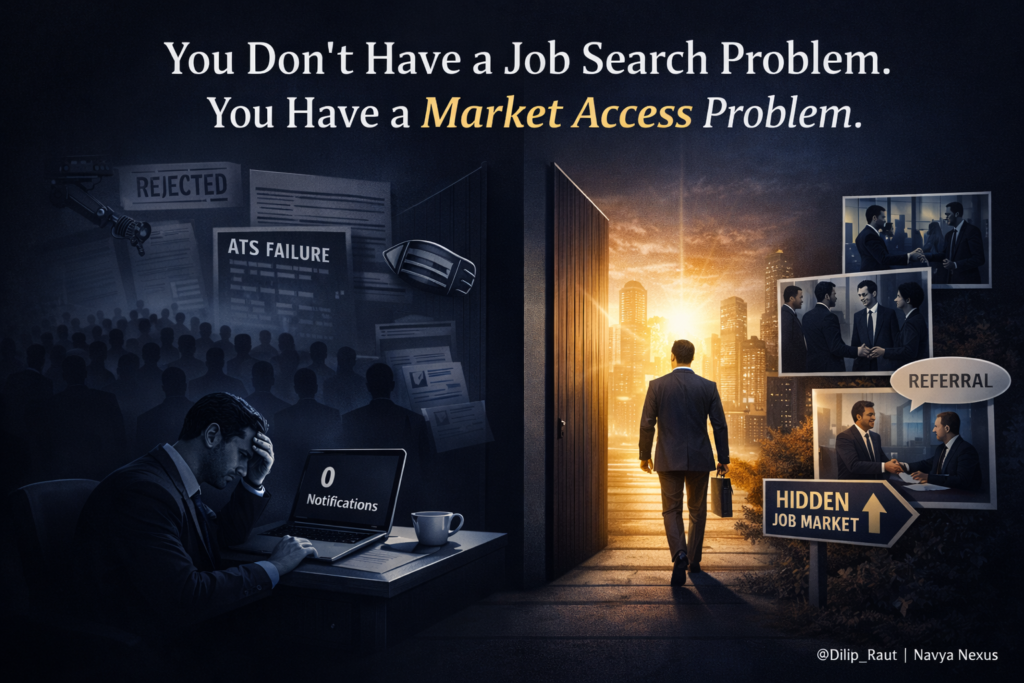
You don’t have a job search problem. You have a market access problem.
What is a Job Search Problem vs a Market Access Problem?
❌ Job Search Problem (What You Think)
- Not applying enough
- Resume not good enough
- Lack of skills or experience
✅ Market Access Problem (Reality)
- You’re applying where everyone else is
- You’re competing in the most crowded channels
- You’re invisible to decision-makers
👉 You’re fishing in the same pond as 1000+ candidates.
The Hidden Reality of Hiring (That Most Candidates Don’t Know)
Most professionals believe jobs come from:
- Job portals
- Company career pages
- LinkedIn job postings
But in reality:
👉 A large percentage of roles are filled without ever being publicly advertised.
This is called the Hidden Job Market.
Where Real Opportunities Actually Come From:
- Internal referrals
- Recruiter networks
- Leadership recommendations
- Direct outreach & conversations
- Talent pipelines built before roles open
👉 If you’re not in these channels, you’re not even in the race.
Why Applying Online is a Losing Strategy in 2026
Let’s break it down:
- A single job post receives 300–1000+ applications
- ATS filters eliminate most profiles before human review
- Recruiters spend 6–10 seconds per resume
👉 Even strong candidates get ignored—not because they’re bad, but because they’re invisible.
The Real Problem: You Lack Market Access
Think of it this way:
- Job portals = Open competition (crowded)
- Hidden market = Controlled access (high conversion)
Top professionals don’t rely on luck.
They position themselves where:
- Recruiters already trust them
- Decision-makers already know them
- Opportunities come through direct conversations
How Top 1% Professionals Actually Get Hired
They don’t “apply more.”
They:
- Build strategic visibility
- Create authority in their niche
- Leverage networks and referrals
- Engage directly with hiring managers
- Stay inside recruiter pipelines
👉 Result: Less effort, better opportunities, faster offers
Signs You Have a Market Access Problem
If you’re experiencing this, it’s NOT your resume—it’s access:
- Applying daily but no responses
- Getting rejected without feedback
- No recruiter reach-outs
- LinkedIn profile not generating inbound opportunities
- Feeling stuck despite experience
The Shift: From Job Seeker → Market Participant
You need to stop acting like an applicant
and start positioning yourself like an in-demand professional.
That means:
- Moving from applications → conversations
- From visibility → credibility
- From effort → strategy
Introducing the Solution: Strategic Market Access
This is exactly where most professionals struggle.
They:
- Don’t know how to access hidden opportunities
- Lack structured outreach strategies
- Fail to position themselves correctly
👉 And that’s where a structured system becomes critical.
🚀 How Navya Nexus Helps You Fix This
At Navya Nexus, we don’t just provide “Job Market Access”
We help you solve the real problem: Hidden Job Market Access.
Our approach includes:
- Career Strategy Audit
- Positioning & Messaging
- Hidden Job Market Access Strategy
- LinkedIn Authority Building
- Recruiter Psychology Insights
- Job Search Strategy & Execution
- Interview Guidance
👉 This ensures you’re not just applying — you’re getting noticed, approached, and hired.
💡 Final Thought
If you keep doing what everyone else is doing…
you’ll keep getting what everyone else is getting:
👉 Silence. Rejections. Frustration.
But once you fix your market access, everything changes.
📩 Ready to Fix Your Job Search Strategy?
If you’re serious about:
- Getting more interview calls
- Accessing hidden opportunities
- Positioning yourself for better roles
Then start with a Career Strategy Audit.
👉 Email: hr@navyanexus.com
We’ll analyze your profile, identify gaps, and give you a clear roadmap to break into the hidden job market.